Thursday afternoon - Downtown Americus and an unusual ice cream shop; Habitat for Humanity International and the Global Village and Discovery Center
We started out looking for ice cream and found "Lollipop Kids". It's a kids clothing store with an ice cream shop in the front of the store. Delicious ice cream cones to fortify us for an afternoon of sightseeing.

We stopped by Habitat for Humanity International Headquarters and enjoyed the hallway of posters which chronicle the development and progress of HFH since it was founded in 1976 by Millard and Linda Fuller when they left very lucrative jobs with the goal "to eliminate poverty housing worldwide."
We then drove just a few blocks to the Habitat Global Village and Discovery Center. The Global Village is comprised of two sections, outdoors that you walk through. The first is an example of the substandard poverty housing that persists in our world today.


 The second section consists of life-size replicas of homes being built by Habitat and its volunteers around the world. Some of the countries represented are Mexico, Guatemala, Kenya, Malawi, Haiti, Uganda, South Africa, India and Sri Lanka. These homes are not "Americanized", but are built using local materials and in keeping with the local customs and climate.


This walk through was especially interesting and informative. Habitat has built more than 200,000 homes in partnership with people in more than 100 countries to help people live in decent, affordable housing. This visit was very inspiring and just reenforced our plans to volunteer some more with Habitat.
Friday - Plains, GA, Jimmy Carter's boyhood home; potluck at campground, bluegrass music
Plains, GA is a small, quiet, well-kept country town. The high school is now a museum and visitor's center; Billy Carter's Service Station is still on the main street and the Carter's still live in their house on Church Street (which is the main street). There is a fence around their property and Secret Service black suburbans parked in the driveway. Their house is surrounded by a lot of trees and is quite a ways off the street, so I wasn't able to get a picture of it. But if you weren't looking for his home, you would never notice it.
The Carter Boyhood Farm is about 3 miles from Plains and is a National Historic Site. The farm is at Archery. Archery was not incorporated or organized in any way; it was just the name of the rural community and train stop. The Carter family moved to the farm in 1928. Jimmy was 4 years old. There was no electricity or running water until 1938. This was home to Jimmy Carter until he left for college in 1941. The National Park Service purchased the home and 17 acres surrounding it from the Downer family who bought it from Mr. Carter in 1949. Mr. Carter's original farm was about 350 acres. The site has been restored to its appearance before electricity. We could hear the squeak of the windmill as it turned in the wind.


 This is Maranantha Baptist Church which Jimmy and Rosalynn Carter attend when they are in Plains. It's located about 1/2 mile out of town. President Carter is a deacon at the church and teaches Sunday School. There is a Sunday School schedule posted at our campground showing the Sundays he will be teaching and the public is welcome to attend. Sunday School starts at 10:30, but you need to go about 2 hours ahead because everyone has to be screened by the Secret Service prior to the service. He was not in town this weekend. We heard from some other campers that the Secret Service people are very friendly and helpful and willing to share about their experiences with their jobs.
Saturday- Village of Andersonville (more ice cream), and Andersonville National Historic Site (met Abraham Lincoln)
We found another store serving ice cream in the town of Andersonville which is across the road from the Andersonville National Historic Site and the National Prisoner of War Museum.
Andersonville, or Camp Sumter as it was officially known, was one of the largest of many Confederate military prisons established during the Civil War. It was built in early 1864 when Confederate officials decided to move the large number of Federal prisoners kept in and around Richmond, Virginia, to a place of greater security and a more abundant food supply. During the 14 months the prison existed, more than 45,000 Union soldiers were confined there. 13,000 died from disease, poor sanitation, malnutrition, overcrowding, or exposure.
The original prison was 16 1/2 acres and was designed for 10,000 prisoners who began arriving in February 1864. By the end of June there were 26,000 with approximately 400 arriving daily. The stockade was expanded by another 10 acres in June 1864. Horrific conditions existed resulting in much suffering and a high mortality.
Andersonville Prison ceased to exist in May 1865 as most prisoners returned to their pre-war occupations. In July and August, Clara Barton, a detachment of laborers and soldiers and a former prisoner named Dorence Atwater, came to Andersonville cemetery to identify and mark the graves of the Union dead. As a prisoner, Atwater was assigned to record the names of deceased Union soldiers. Fearing loss of the death record at war's end, Atwater made his own copy in hopes of notifying the relatives of some 12,000 dead interred there. Thanks to his list and the Confederate records confiscated at the end of the war, only 460 of Andersonville graves had to be marked "unknown U.S. soldier." It's very sobering to walk and drive around the prison area and then drive through the cemetery.
In 1998 the National Prisoner of War Museum opened at Andersonville and is the only National Park System area to serve as a memorial to all American prisoners of war and is dedicated to the men and women of this country who suffered captivity. Some Americans have experienced the prisoner of war ordeal for a few days, others for years. All have experienced the loss of freedom. This is the most important story told at Andersonville National Historic Site. To fully understand this loss is to cherish freedom all the more.
I took pictures at Andersonville, but they just don't describe the feelings and emotions of this place.
On a lighter note, we did meet Abraham Lincoln strolling the ground of the prison site. Dennis Boggs portrays Lincoln as a profession and was visiting Andersonville a few months ago when one of the park rangers asked, "Has anyone told you that you look a lot like Abraham Lincoln?" Mr. Boggs gave the park ranger one of his brochures and the park service asked him to spend a few weeks at the park. He visits with visitors and gives talks twice a day regarding Lincoln's life.

On Friday evening our campground hosted a barbeque. Several of the men smoked pork loins and pork shoulders all day and everyone brought a dish to share. Bluegrass music was provided by a couple of people from the campground and some local folk who just came to play. Nice ending to a very busy day.
I didn't intend for this post to be so long, but some things just don't condense very well. I have a lot more pictures and am thinking of storing all of them on smugbug.com so you can see all of them. Probably won't get them transferred until we get back home, but will let you know when that happens.
One more thing>>>
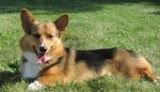
Went to a church with our campground neighbors, Gerry and Joan, this morning. They are from Pennsylvania and are trying to escape cold weather also. They don't plan to fulltime, but are retired and plan to do a lot of traveling in their RV. They have an 11 year old peek-a-boo who thinks she is the "queen bee". She is a very good dog, but just ignores Kasey. And Kasey just leaves her alone. They get along fine. They just ignore each other. I'll post her picture tomorrow.
We all went for lunch at Cutt's Restaurant. There is no menu at Cutt's. There are lists behind the counter which list the buffet items for everyday. Fried chicken is always served. Customers walk in the front door and proceed to the counter to view the food offered for the day. Today was fried or baked chicken, turkey & dressing, roast beef, pork chops, mashed potatoes, squash casserole, rice, black-eyed peas, lima beans, and collared greens. You choose one meat and 3 sides; then you choose either a biscuit, cornbread or flatbread. The lady behind the counter dishes up your food as you choose it. And she is very liberal with her servings. No need for seconds. We had a great time with these new friends.
More later.....


 As Dan looked out one of the windows, he said, "That's a Bomarc out there." Of course, we had to go look at it. Just like the Link Trainer story, I've heard stories of his time at The Cape working on the Bomarc, but never knew what a Bomarc missile looked like. But I soon found out. Sixty-seven Bomarcs were launched from Cape Canaveral between September 10, 1952 and April 16, 1960. Dan worked on the refrigeration portion of this missile.


 Our guide talked about the many rocket and missile launches from the Cape which never made it off the ground and the years of research and training that go into each launch. And the changes that are made based on each previous experience. Dan has also spoken of the various missile launches that were attempted and never made it off the ground, but until you've stood where these men died, you don't really appreciate what has gone into our space program.


 Kasey in his favorite spot in the motorhome, overseeing the "getting ready to go" process. "Are they ready yet?"
 Entering Florida
 The latest Blue Angel Pilot (wannabee). Notice there are no wings or engines and the rear of the plane is missing. I think we are pretty safe.
 I was especially interested to see this Link Trainer. My aunt, Hazel Rishel, was in the WAC (Women's Army Corps) during World War II. She was stationed in Japan, California, Aberdeen Proving Ground in Maryland and other places that I've forgotten. My mother always said that Aunt Hazel was a "Link Trainer" and trained pilots to fly. I never knew for sure what that involved, so I'll share what I learned about that.




 Posts

